Table of Contents
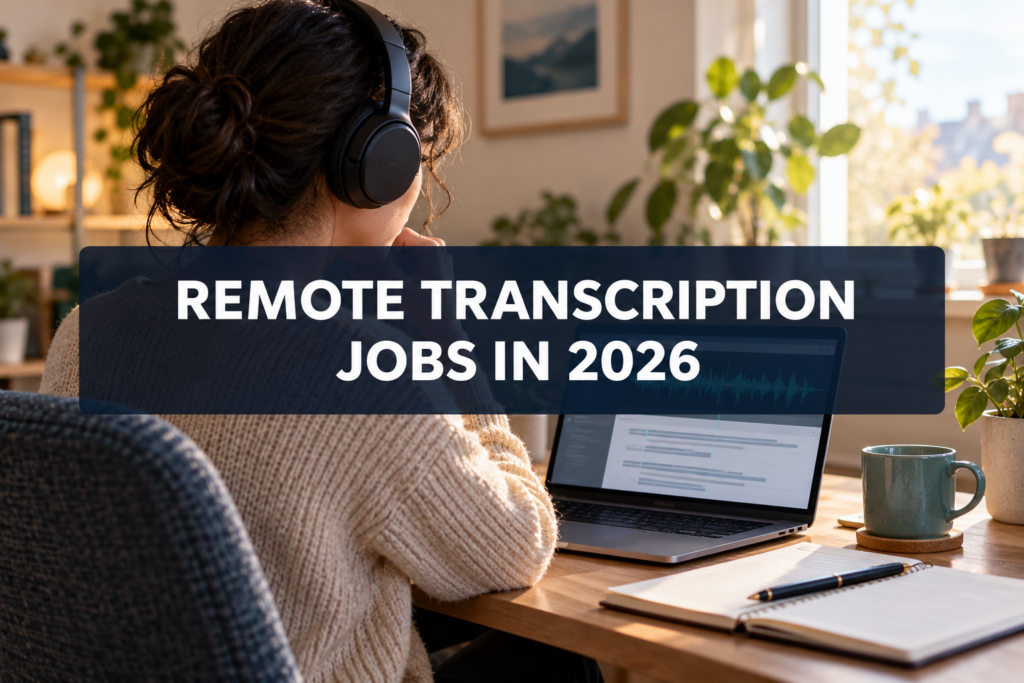
Remote transcription is often advertised as simple typing work. In practice, the job is closer to careful listening, research, editing and quality control. A clean recording with one speaker may be straightforward. A meeting with overlapping voices, technical vocabulary and poor audio can take several times longer than its recorded length.
AI has changed the workflow, but it has not removed the need for human judgment. Clients still need someone to identify speakers, correct names, preserve meaning, follow formatting rules and notice when an automated transcript is confidently wrong. The opportunity in 2026 is therefore broader than typing every word from scratch: it includes transcript cleanup, caption timing, subtitle translation and specialist review.
This guide explains what the work involves, how platform rates should be interpreted, what to put in a starter portfolio and how to avoid misleading job offers.
Start with the four main service types
General transcription converts interviews, meetings, podcasts or research recordings into readable text. Captioning adds timing and sound information so video can be followed without audio. Subtitle translation preserves meaning in another language while fitting timing and space limits. Legal or medical work may require specialist terminology, formatting and confidentiality procedures.
Do not present these as interchangeable skills. A fast typist may still struggle with speaker identification. A strong translator may need practice with subtitle timing. Specialist records can have consequences far beyond a normal blog transcript, so never claim legal or medical expertise you do not have.
Rev’s current freelancer page illustrates the distinctions. It lists transcription, captioning, subtitle translation and legal transcription as separate roles, each with its own stated per-audio-minute range and requirements. It also says applications are currently subject to a waitlist. Treat that page as one platform example, not proof that work or approval is guaranteed.
Understand the rate before estimating income
An “audio minute” is one minute of recording, not one minute of your labor. If a ten-minute recording takes forty minutes to transcribe and check, a rate of $1 per audio minute produces $10 for forty minutes before taxes, fees, unpaid research and waiting time. Difficult audio can take longer.
Run a timed sample before accepting a project. Divide the total project pay by all working time: downloading, listening, researching names, formatting, quality checks, revisions and administration. That effective hourly figure is more useful than the advertised audio-minute rate.
Platform queues and client demand can also fluctuate. A published range does not tell you how many suitable files will be available, whether you will qualify for them, or how much work will pass review. Build budgets from completed, approved work rather than a theoretical maximum.
Build the skills that automation does not solve
Accuracy begins with disciplined uncertainty. Mark an inaudible passage according to the client’s rules instead of inventing a plausible sentence. Verify names through reliable context, but do not “correct” a speaker’s meaning. Keep verbatim speech when the specification requires it and produce clean readable prose only when authorized.
Practice these skills:
- distinguishing speakers without relying only on pitch;
- researching names, products and technical terms;
- applying consistent punctuation and capitalization;
- using timestamps and non-speech labels correctly;
- checking numbers, dates and proper nouns separately;
- protecting confidential recordings and deleting local copies when required.
AI can create a first draft, but you remain responsible for every submitted line. Never upload a client’s confidential audio to an unapproved service. The fastest tool is not useful if its use breaches a contract or exposes private material.
Create a three-piece starter portfolio
Use recordings that you created, licensed for reuse, or that are clearly in the public domain. Do not download a random podcast and imply that the publisher hired you.
Prepare three short samples. The first should be a clean two-speaker interview with speaker labels. The second should contain moderate background noise and show responsible inaudible markers. The third should demonstrate a specialty: timed captions, bilingual subtitles or a terminology-heavy passage you are genuinely qualified to handle.
For each sample, include a brief specification: clean or verbatim, timestamp convention, language, audio length and turnaround time. Add a before-and-after excerpt if you used an automated draft, explaining the types of errors you corrected. This demonstrates editorial judgment without exposing a client’s data.
The site’s skills evidence portfolio guide can help you frame these samples as proof rather than decoration.
Test your real production speed
Choose a five-minute recording and time the complete process. Complete it once manually and once with an approved automated draft. Record the time spent on listening, corrections, research and final quality assurance.
Then compare error categories: omitted words, wrong names, punctuation, speaker attribution, numbers and misunderstood jargon. This test will show whether AI actually saves time for that audio type. It can also reveal the niche in which you are strongest.
Do not advertise a turnaround based on your easiest test. Leave capacity for file problems, client questions and a final listen. Consistent delivery is more valuable than a promise that forces careless work.
Search for work beyond one platform
Search for transcriptionist, caption editor, subtitle translator, transcript proofreader, podcast show-notes assistant and qualitative-research transcription. Check platform freelancer pages directly and verify agency openings on the organization’s own website.
You can also approach researchers, podcasters, video producers and localization agencies with a specific service. “I provide English transcription” is broad. “I turn 30–60 minute founder interviews into speaker-labeled transcripts and a checked list of names” is easier to evaluate.
For client work, define audio quality, number of speakers, timestamps, verbatim level, formatting, confidentiality, revision scope and deadline before quoting. Ask for a representative sample when possible.
Use the site’s LinkedIn job-search guide to refine searches, then verify every opening at its source.
Screen offers and protect your files
A legitimate client may request a short skills test, but an unpaid test should be limited and clearly for evaluation. Be cautious if someone sends hours of usable audio as a “test,” asks you to buy equipment through an unknown vendor, or promises unusually high income for effortless typing.
The FTC advises job seekers not to pay for the promise of a job or deposit a check and return part of the money. Independently confirm the company and recruiter before providing identity or banking information. The site’s remote-job scam checklist gives a broader verification process.
Keep client files in an access-controlled folder. Use strong unique passwords and multifactor authentication where available. Clarify whether recordings may be stored in cloud tools, how long files should be retained and whether subcontracting is prohibited.
A practical 14-day start plan
Days one to three: choose a service, read a current style guide and practice on short lawful recordings. Days four to six: create your three samples and track production time. Day seven: calculate a minimum acceptable effective rate.
Days eight to ten: build a one-page portfolio, write a precise service description and prepare questions for prospective clients. Days eleven to thirteen: apply to a small number of verified opportunities and send targeted pitches. Day fourteen: review which samples and messages produced responses.
Do not buy expensive equipment immediately. A reliable computer, secure internet connection and good headphones are enough to test general work. Specialist hardware or training should solve a confirmed need, not substitute for practice.
The realistic conclusion
Remote transcription can be flexible, but it is not passive income and availability is not guaranteed. The strongest position in 2026 is accuracy plus context: reliable listening, research, formatting, privacy and transparent use of automation.
Measure income against actual working time, build samples you can explain, and specialize only when you have the knowledge to do so safely. That approach will not produce instant earnings, but it gives clients a credible reason to trust your work.
